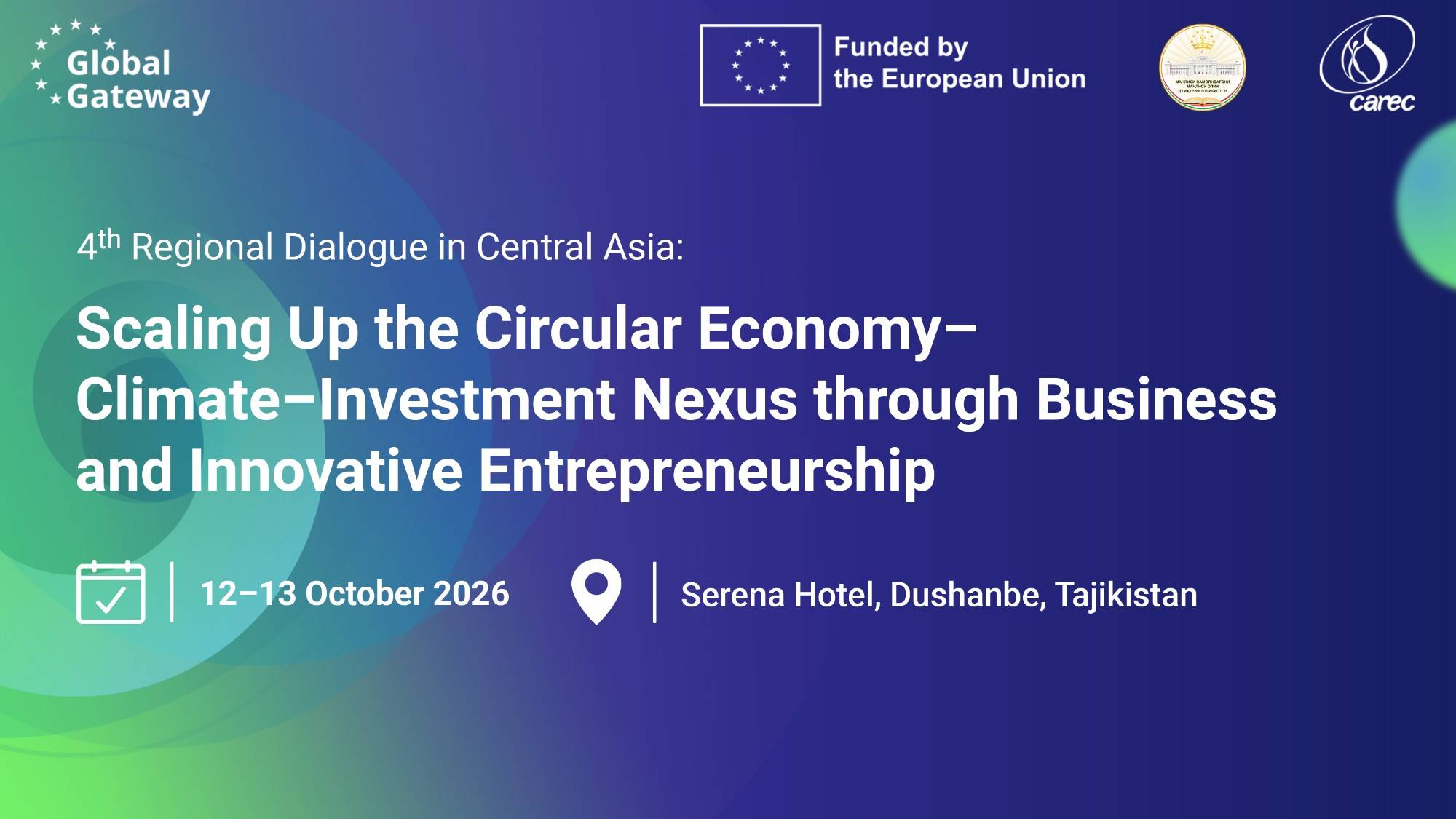
WHEN: 12-13 October 2026 I TIME: 9:00 - 19:00 (Dushanbe Time) I VENUE: Serena Hotel, Dushanbe, Tajikistan I Hybrid Event - REGISTER Here
Background
In recent years, there has been a growing interest in circular economy among governments in Central Asia, accompanied by an increasingly mature understanding that circularity extends well beyond waste management and recycling. There is growing acknowledgement of the broader vision of a circular economy — one that spans the full value chain, from resource use and product design to life extension and material recovery — and is increasingly recognised as a cross-cutting economic and industrial agenda rather than a purely environmental one. This growing regional interest is reflected in the emergence of the Central Asia Circular Economy Partnership Framework as a shared institutional platform for regional cooperation, and in the progressive mainstreaming of circular economy principles across national development policy, including in updated Nationally Determined Contributions (NDCs), Decarbonization and Green Growth Strategies, and emerging climate finance initiatives. Taken together, these developments signal a maturing regional narrative in which circular economy is increasingly framed as a driver of climate action, economic diversification and sustainable investment, rather than a standalone, waste-centric theme.
EU Global Gateway Strategy
The EU's Global Gateway is the EU's strategy to mobilise up to EUR 300 billion for sustainable, smart and secure infrastructure investment worldwide, spanning digital connectivity, climate and energy, transport, health, and education and research. Within this strategy, Global Gateway places strong emphasis on supporting partner countries' investments in climate mitigation and resilience and clean energy, contributing directly to the climate-neutrality ambition at the heart of the European Green Deal. Sustainable consumption and production, together with the transition to a circular economy, are integral to green, resource-efficient growth. By fostering policy dialogue, knowledge exchange, and legislative engagement, the SWITCH-Asia Programme connects Central Asia with the Global Gateway agenda and supports the region's transition toward circular value chains enhancing regional sustainability, economic resilience, and alignment with international and EU policies.
The 4th Regional Dialogue on Circular Economy of the Central Asian Parliamentarian Platform
The Regional Dialogue on Circular Economy of the Central Asia Parliamentarian Platform was designed to create conditions for further strengthening cooperation on the implementation of circular economy principles in the region and, thereby, nationally. Three successful regional dialogues have been convened so far, bringing together parliamentarians from Kazakhstan, Kyrgyzstan, Tajikistan, Turkmenistan and Uzbekistan, as well as representatives of governments, the European Union, CAREC, the business community, expert organisations, financial institutions and specialists from the SWITCH-Asia Programme.
- 1st Dialogue – Bishkek, May 2025: built a shared understanding of circular economy (CE) and sustainable consumption and production (SCP) concepts among parliamentarians from all five Central Asian countries. (Download the Report)
- 2nd Dialogue – Almaty, 13–14 October 2025: focused on “Strengthening Policy Ambitions in Sustainable Consumption and Production and Circular Economy.” (Download the Report)
- 3rd Dialogue – Tashkent, 9–10 April 2026: examined “Business Innovation and Finance Impacts through Sustainable Consumption and Production (SCP) and Circular Economy (CE).” The Parliamentarians made valuable contributions to the development of the Central Asia Circular Economy Partnership Framework, subsequently launched at the Regional Ecological Summit 2026. (Download the Report)
Building on this momentum, the Fourth Regional Dialogue will focus on scaling up the impacts already generated through business engagement, innovative entrepreneurship and investment — moving the Platform from concept-building and policy ambition towards practical implementation. The Dialogue will further explore how government leadership, complemented by private-sector, financial-sector and academic collaboration on innovation, can help steer countries towards high-value, resource-efficient sectors. It will also, more explicitly than in previous dialogues, strengthen the discussion on building synergies within the Circular Economy–Climate–Investment nexus — including NDC 3.0 and Decarbonization and Green Growth Strategies, and the EU Global Gateway pipeline of investment — so that Parliamentarians can engage with CE as a converging policy, climate and investment agenda rather than a standalone, waste-centric topic, and so that these synergies can be used to promote a higher level of finance and investment mobilisation across the region. In addition to in-room discussion, the event will include a field visit demonstrating circular economy practices in or near Dushanbe.
Discussions in Dushanbe will also feed directly into implementation of the Central Asia Circular Economy Partnership Framework, launched at the Regional Ecological Summit 2026, linking ongoing parliamentary engagement to longer-term regional environmental and climate governance. To ground the Dialogue in the most current picture in each country, national experts are preparing short country-level “signals” briefs tracking emerging CE trends across four lines of enquiry — policy signals, key actors and institutional mechanisms, CE–climate linkages, and business/private-sector trends — which will inform the country update session below.
Invited participants: EU INTPA HQ, EU Delegations in Central Asia, SWITCH-Asia Policy Support Component (PSC), Members of Parliament (MPs) nominated by the five Central Asian Parliaments, SWITCH-Asia National Focal Points (NFPs), other representatives of governments in the Central Asian region working on circular economy and climate, partners, experts of the relevant Technical Advisories under SWITCH-Asia, and stakeholders of the SWITCH-Asia Technical Advisories, relevant international financial institutions and development partners, and representatives of CAREC and country offices.
Objectives
- Promote and Enhance Regional Cooperation: Facilitate knowledge exchange and discussions on regional challenges and opportunities for scaling up circular economy practices in Central Asia.
- Strengthen Parliamentary Engagement: Equip parliamentarians with updated evidence and tools to advocate for and legislate CE, climate and investment-enabling policies in their respective countries.
- Discuss Emerging Developments, Trends and Opportunities: Foster a discussion, informed by country-level briefs, on the opportunities created within the emerging developments and trends over the past two years in the areas of policy, institutions, climate linkages and business activity.
- Strengthen the Circular Economy-Climate-Investment Nexus: Strengthen the discussion on building synergies between circular economy, climate action and investment, and promote a higher level of finance and investment mobilisation through these synergies — including by exploring how circularity can be more explicitly reflected in NDC 3.0 and Decarbonization and Green Growth Strategies, and by showcasing financing instruments, DFI/MDB tools and EU Global Gateway opportunities that can de-risk and scale circular economy and climate investment.
- Facilitate Engagement between Policy Makers, Business and Finance: Engage businesses, entrepreneurs and financial institutions in showcasing circular and climate-smart solutions to MPs, strengthening mutual understanding and collaboration for effective policy and investment.
- Advance the Partnership Framework: Contribute to implementation of the Central Asia Circular Economy Partnership Framework and consolidate the Platform's role as a standing parliamentary mechanism.
Agenda
|
Duration |
Session |
Speakers |
|
12 October 2026 |
||
|
08:30–09:00 30 minutes |
Registration |
|
|
09:00–09:45 45 minutes |
Welcome and Opening Remarks Overview of the Dialogue's goals: scaling up circular economy impacts through business, innovative entrepreneurship and investment, and strengthening CE–climate linkages. |
Emcee (throughout the programme): Ranga Pallawala, SWITCH-Asia PSC
|
|
09:45–11:00 1 hour 15 minutes |
Session 1: Country Updates – Emerging CE, Climate and Investment Developments Introduction to the session and to the country-level briefs prepared by national experts since the 3rd Dialogue. Country interventions by parliamentarians, delivered from the podium without slide presentations (10 mins each): what has changed in each country's CE conversation on (i) policy, (ii) institutions/actors, (iii) climate linkages and (iv) business/investment activity since the 1st–3rd Dialogues. |
Moderator: Dr. Zinaida Fadeeva, Team Leader, SWITCH-Asia PSC
|
|
11:00—11:30 30 minutes |
Break and Group Photo |
|
|
11:30—12:30 1 hour |
Session 2 (Part 1 of 2): Circular Economy in Business — From Practice to the Climate Investment Opportunity Objective: move from concrete business practice to a wider policy and business discussion on the circular economy–climate nexus, in two connected segments split by lunch. Opening Framing (10 min) Situates the session within the Central Asia Circular Economy Partnership Framework, the EU Global Gateway pipeline, and NDC 3.0 / Decarbonization and Green Growth Strategies processes; introduces the two angles the session will explore — business practice in integrating CE, and how the CE–climate nexus is shaping business and investment strategy — and positions MPs as actors in that convergence. Segment 1 (50 min): Business Case Showcases — Integrating Circular Economy into Business Practices Business and project case introductions (5 min each): what circularity practice was/is implemented; how markets and financing were secured; risks identified and how they were de-risked. Interactive discussion with businesses, financiers and parliamentarians on policy options and market enablers to scale up similar projects. |
Opening Framing Dr. Zinaida Fadeeva, Team Leader, SWITCH-Asia PSC
Segment 1 Moderator: Dr. Rene van Berkel, Senior Expert on Circular Economy, SWITCH-Asia Panel participant from Tajikistan:
Panel participant from Kazakhstan:
Panel participant from Kyrgyzstan:
Panel participant from Turkmenistan:
|
|
12:30 – 13:30 1 hour |
Lunch |
|
|
13:30 – 15:00 1 hour 30 minutes |
Session 2 (Part 2 of 2): Circular Economy in Business — From Practice to the Climate Investment Opportunity Transition (10 min) The moderator reconnects with the business cases presented before lunch, drawing out the climate dimension already visible in them and framing the shift from operational practice to strategic investment positioning. Segment 2 (1 hour 20 minutes): The CE–Climate Nexus — Business and Policy Perspectives on Emerging Opportunities Format: panel discussion bringing together representatives of investment promotion, development finance institutions and the private sector to examine how the convergence of circular economy and climate agendas is reshaping investment decisions and corporate strategy — from de-risking and access to green/blended finance to competitiveness and market positioning. Guiding discussion question: what policy signals would help more circular businesses build climate considerations into their investment case, and more investors treat circularity as a climate-relevant asset class? |
Moderators: Dr. Rene van Berkel and Ranga Pallawala, SWITCH-Asia PSC Segment 2 — Panel Discussion Statement from Tajikistan:
|
|
15:00 – 15:30 |
Break |
|
|
15:30 –17:00 1 hour 30 minutes
|
Session 3: Leveraging Circular Economy Investments for Climate Ambition and Climate Finance A standalone session that gradually transitions from the business and policy discussion in Session 2 towards the public climate finance and national climate ambition dimension of the nexus. Objective: explore circular economy investment as a lever for climate ambition — examining how CE-linked initiatives (e.g. resource-efficient industry, materials recovery, sustainable construction) can be positioned to draw down climate finance, and how stronger recognition of CE within NDC 3.0 and Decarbonization and Green Growth Strategies can, in turn, widen the pool of climate-labelled capital available for circular investment. Guiding discussion question: what would it take for a circular economy project to qualify, in practice, as a climate investment — and what should parliamentarians do to close that gap? |
Moderator: Ranga Pallawala, SWITCH-Asia PSC Scene Setting Presentation by the Moderator Panellists
Discussion with MPs |
|
30 minutes |
Break |
|
|
18:00
|
Welcome Reception and Networking Dinner, Hosted by the Tajikistan Organising Partners |
All participants Venue: Bahor-Forel Restaurant, Prospekt Hofizi Sherozi 5, near Chorbog terminal, Ismoili Somoni district, Dushanbe Transport: minibus departing from the Serena Hotel at 18:00 |
|
Duration |
Session |
Speakers |
|
13 October 2026 |
||
|
Visit to the Parliament of the Republic of Tajikistan followed by the enterprise visit (LLC “Akia Avesto Automotive Industry”) |
||
|
08:30–08:40 |
Participants gather at Serena Hotel Group assembly and preparation for departure to the Parliament of the Republic of Tajikistan. Departure – 08:40 |
All participants |
|
09:00–10:20 |
Visit to the Majlisi Namoyandagon of the Majlisi Oli of the Republic of Tajikistan 09:00–09:10 – arrival and entry to the Parliament building. 09:10–09:30 – welcome meeting and reception of participants. 09:30–09:50 – briefing on legislative processes. 09:50–10:20 – guided tour of the Parliament. |
Briefing on legislative processes: representative of the Committee on Legislation and Human Rights of the Majlisi Namoyandagon |
|
10:30–11:00 |
Transfer to the production facility Departure from Parliament and transfer to Akia Avesto LLC. |
All participants |
|
11:00–11:40 |
Visit to Akia Avesto LLC Guided factory tour and introduction to the production of buses and electric buses. |
Mr. Dzhalil Abdullaev, Executive Director, LLC “Akia Avesto Automotive Industry” |
|
11:40–12:10 |
Return to Serena Hotel Transfer from the production facility to the hotel before lunch. |
All participants |
|
12:20–13:20 |
Lunch |
|
|
13:30–14:00 |
Recap of Day 1 and the Visits, and Overview of the Afternoon |
Recap of Day 1: Dr. Rene van Berkel, Senior Expert on Circular Economy, SWITCH-Asia Recap of the visits: Dr. Zinaida Fadeeva, Team Leader, SWITCH-Asia PSC, and Dr. Rene van Berkel, Senior Expert on Circular Economy, SWITCH-Asia |
|
14:00 – 15:15 1 hour 15 minutes |
Session 4: Parliamentary Action Lab Objective: parliamentary policy priorities for scaling up circular economy, climate and investment action. Format: roundtable breakout discussions (by country) — parliamentarians identify 2–3 priority legislative or policy actions (e.g. CE taxonomy, tax incentives, risk guarantees, GPP reform, EPR legislation, integration of CE into NDC / Decarbonization and Green Growth Strategies). Outcome: each group presents a short action list feeding a regional Action Agenda. |
Moderated by Dr. Zinaida Fadeeva, Team Leader, SWITCH-Asia PSC, assisted by national experts All participants |
|
15:15 – 15:30 15 minutes |
Break |
|
|
15:30 – 17:00 1 hour 30 minutes |
Meeting of Parliamentarians (By Invitation) To take stock of the Central Asia Circular Economy Partnership Framework's MP group and agree next steps. Tea/coffee included in this session. |
Co-chairs:
|
|
17:00 – 17:30 30 minutes |
Session 5: Closing Session Key takeaways from the Dialogue; vote of thanks; departures. |
Emcee: Ranga Pallawala, SWITCH-Asia PSC Action Lab outcomes: Dr. Zinaida Fadeeva, Team Leader, SWITCH-Asia PSC Closing remarks:
All participants |