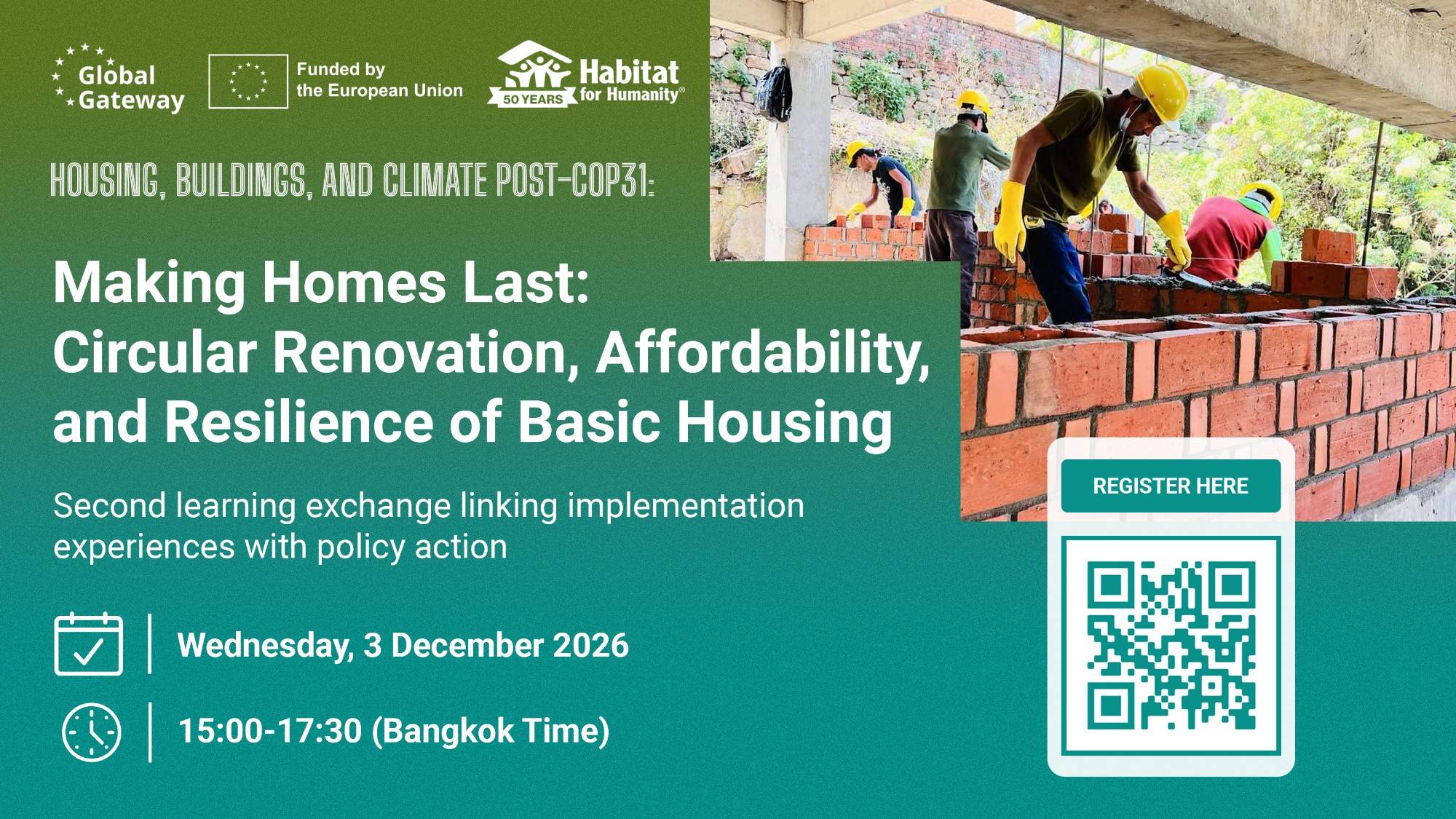
WHEN: 3 December 2026 I TIME: 15:00 - 17:30 (Bangkok Time) I REGISTER Here
Background
Across Asia and the Pacific, millions of households face the combined pressures of rising housing costs, climate-related disasters and inadequate living conditions. Low- and middle-income families, particularly those living in informal or poorly constructed homes, are disproportionately exposed to floods, cyclones, earthquakes and extreme temperatures, while often lacking the financial resources needed to maintain, repair or improve their homes.
According to Habitat for Humanity's Home at What Cost? global survey, 75% of respondents have reduced spending on at least one essential expense to afford housing, increasing to 89% among people living in informal housing arrangements. These findings highlight the urgent need for housing solutions that are not only affordable but also safe, durable and resilient to climate change.
Renovating, maintaining and extending the lifespan of existing homes offers an opportunity to address these interconnected challenges while advancing the transition to a circular economy. By reducing demand for new construction materials, promoting reuse and recycled materials, improving resource efficiency and preventing avoidable damage, circular approaches can contribute to lower lifecycle costs, reduced environmental impacts and improved housing resilience.
Building on their ongoing collaboration, the EU SWITCH-Asia Policy Support Component (PSC) and Habitat for Humanity Asia-Pacific are joining forces to explore how circular economy principles can translate into practical, affordable and climate-resilient housing solutions. Combining SWITCH-Asia's expertise in circular construction, material efficiency and enabling policy frameworks with Habitat for Humanity's experience in housing affordability, household needs and post-disaster recovery, the webinar will examine renovation and life extension of existing homes through three complementary perspectives: circularity, affordability and resilience. Through practical country experiences and policy discussions, the session will explore opportunities, existing challenges and the enabling conditions needed to scale up sustainable housing solutions across the region.
From Climate Commitments to Implementation: NDC 3.0 and COP31
As countries move towards the implementation of their latest Nationally Determined Contributions (NDC 3.0) under the Paris Agreement, the construction and housing sectors offer significant opportunities to strengthen climate mitigation, adaptation and resource efficiency. The EU SWITCH-Asia PSC has supported national governments across South Asia, Central Asia and the Pacific in integrating circular economy approaches, sustainable consumption and production, and material efficiency into climate policy frameworks. However, translating national climate commitments into practical interventions requires stronger connections between NDC priorities, building regulations, construction standards, public procurement, financing mechanisms and household-level needs.
Following the 31st United Nations Climate Change Conference (COP31), taking place in Antalya, Türkiye, from 9 to 20 November 2026, this webinar will provide an opportunity to reflect on relevant developments for the buildings and housing sectors.
Drawing on a joint review of selected countries where both organisations operate, experts will discuss how housing renovation, building resilience and circular material use are reflected in national climate commitments, identify potential gaps and explore opportunities for strengthening implementation. Particular attention will be given to policies, investments and financing instruments that can help translate climate ambitions into tangible benefits for vulnerable households.
Webinar Objectives
The webinar aims to demonstrate how renovation and life extension of existing homes can make housing more circular, more affordable, and more resilient at the same time, which technical and policy solutions and financing instruments are needed, and how climate commitments can translate into them.
Specific Objectives
- Place households at the centre of the discussion: Examine the challenges faced by low- and middle-income households in maintaining safe, affordable and climate-resilient homes, including the implications for construction materials and resource use.
- Showcase circular construction solutions: Present practical approaches and country experiences involving material efficiency, reuse and recycled materials, building renovation, preventive maintenance, green public procurement and construction standards.
- Connect climate commitments with policy action: Explore how NDC 3.0 priorities and relevant COP31 developments can inform building policies, housing resilience measures and investment planning.
- Address financing and implementation challenges: Discuss financial instruments, incentives and partnerships that can make circular and resilient renovation and rebuilding more affordable and financially viable.
- Identify opportunities for continued collaboration: Highlight priority areas for further joint action between SWITCH-Asia, Habitat for Humanity and regional stakeholders, including potential follow-up discussions at the annual event in May 2027.
Expected Outcomes
The webinar is expected to contribute to a shared understanding of how circular economy approaches can strengthen housing affordability and climate resilience, identify policy and financing gaps affecting implementation, and highlight practical opportunities for scaling up solutions. The discussion will also help identify potential areas for continued cooperation and knowledge exchange between policymakers, housing practitioners, development partners and financial institutions.
Who Should Attend?
The webinar welcomes policymakers and government representatives working on climate change, housing, construction and urban development; development organisations and international partners; building and construction professionals; financial institutions; researchers; civil society organisations; and stakeholders engaged in circular economy, sustainable housing and climate resilience.