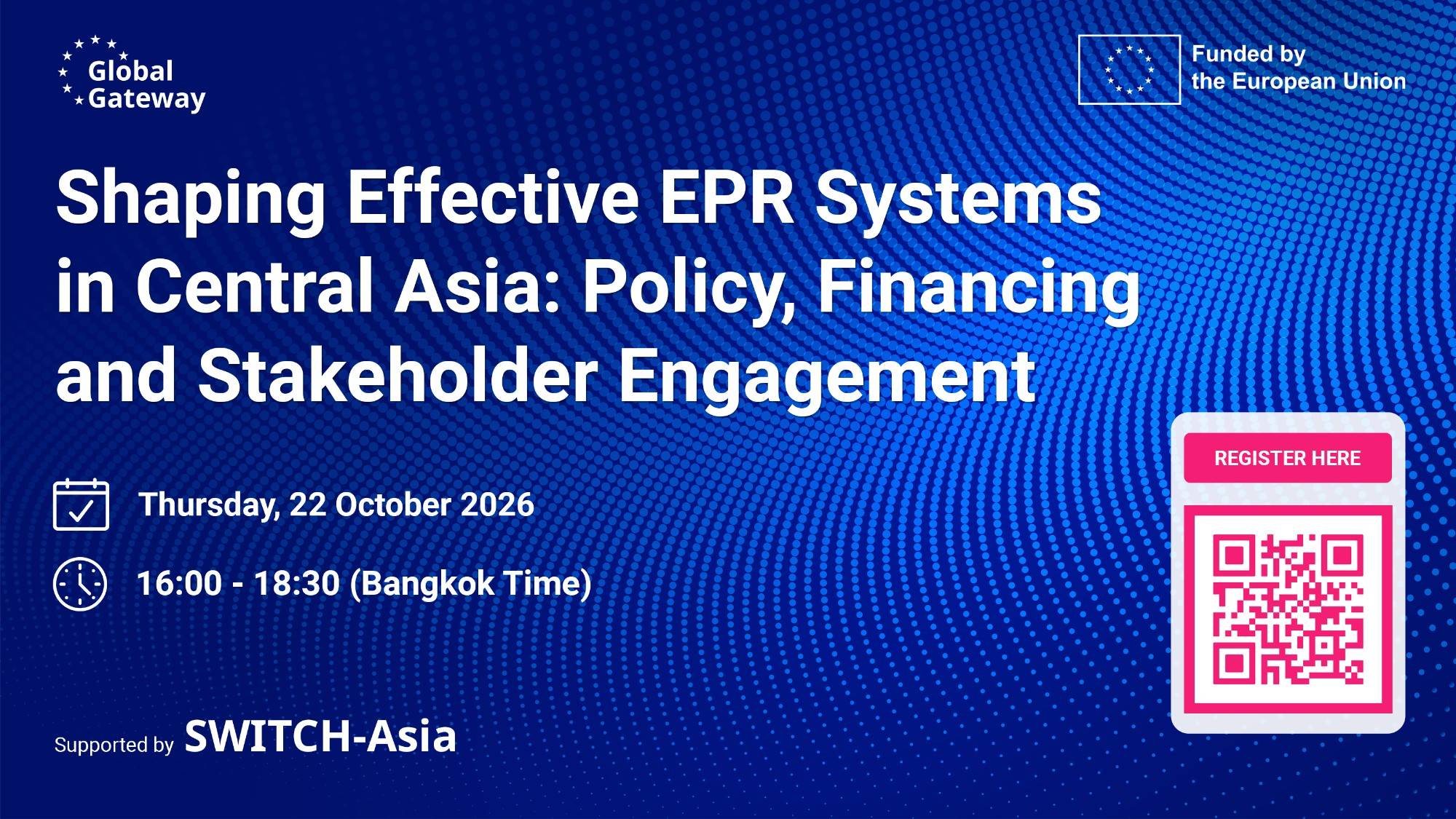
WHEN: 22 October 2026 I TIME: 16:00 - 18:30 (Bangkok Time) I Register HERE
Background
Extended Producer Responsibility (EPR) is an important policy instrument for reducing the environmental impacts of products throughout their life cycles and advancing the transition towards a circular economy. Since its introduction as a policy principle in 1990, EPR has expanded significantly worldwide. By shifting greater responsibility for post-consumer products and packaging towards producers, EPR can help improve waste collection and recycling, reduce material use, encourage more recyclable product design, and internalise environmental costs. More than 400 EPR systems now operate globally. Alongside well-established systems in the European Union, EPR approaches are advancing across Asia, including in India, Malaysia, the Philippines, Thailand and Viet Nam. In Central Asia, Kazakhstan and Uzbekistan have introduced EPR mechanisms, while other countries are developing approaches suited to their national contexts. As these systems evolve, important lessons are emerging around institutional responsibilities, priority waste streams, producer obligations, tariffs and financing, recycling incentives, infrastructure investment, public participation and inclusion of informal-sector actors.
About the SWITCH-Asia Technical Advisory
This Technical Advisory (TA), implemented under the EU SWITCH-Asia Policy Support Component, supports the development and strengthening of EPR systems as a tool for advancing circular economy and sustainable consumption and production in Central Asia.
It builds on Phase I, implemented in 2024–2025 across Kazakhstan, Malaysia, Pakistan, the Philippines and Thailand.
The Central Asia phase has focused on:
-
Capacity building and regional knowledge exchange, including five briefing reports and four webinars;
-
Targeted policy support to Kazakhstan, drawing on its longer-standing EPR experience;
-
Policy consultations with Central Asian countries based on national priorities and requests.
Webinar
This webinar will consolidate the results of the Technical Advisory and provide a platform for policymakers, experts and stakeholders to discuss how EPR systems can be strengthened across Central Asia.
Analytical work prepared by Thomas Lindhqvist, with support from the project team, will inform discussions on:
-
Alternative EPR models and institutional arrangements;
-
Tariffs and financing of EPR systems;
-
Waste inventories and priority materials;
-
Subsidies and incentives for recycling;
-
Public participation and political support.
Participants will also explore opportunities for future cooperation and advisory support from European EPR organisations and associations. The event will additionally present selected findings from a UNEP-supported assessment of EPR systems and their potential in Central Asia, contributing further evidence and regional perspectives to the discussion.
Through this exchange, the webinar aims to support the development of effective, financially sustainable and context-appropriate EPR systems across Central Asia.
Agenda
|
Time |
Topic |
Speakers |
|
14:00 - 14:05 |
Moderator |
Mr. Yerbol Orazbekov, SWITCH-Asia PSC Expert. |
|
14:05 - 14:10 |
Photo Session |
SWITCH-Asia Team |
|
14:10 - 14:20 |
Welcome Remarks |
Dr. Zinaida Fadeeva, SWITCH-Asia PSC Team Leader |
|
14:20 – 14:35 |
Panel session on textile waste management/recycling within the EPR system. |
Lucyl Staub — Extended Producer Responsibility in the textile sector: European realities. |
|
14:35 – 14:50 |
Harsha Vardhan — H&M’s perspective on EPR in the textile industry and the establishment of a synthetic textile recycling plant in Saigon. |
|
|
14:50 - 15:20 |
Presentation: Lessons learned from the SWITCH-Asia project on EPR implementation in Central Asia |
Dr. Thomas Lindquist, International Expert on EPR Reform Support in Central Asia, SWITCH-Asia PSC. |
|
15:20 - 15:35 |
Panel session: How EPR organizations can enhance their performance through cooperation with European professional associations. |
Joachim Quoden, Managing Director, EXPRA. |
|
15:35 - 15:50 |
Pascal Leroy, Director General, WEEE Forum (to be confirmed) |
|
|
15:50 - 16:05 |
What matters for EPR systems in Central Asia from a business perspective |
Alexandra Akkirman, Coca-Cola (to be confirmed) |
|
16:05 - 16:20 |
UNEP project on EPR system analysis in Central Asia — Brief presentation |
Speaker: to be confirmed |
|
16:20 - 16:30 |
Concluding Remarks |
Moderator: Zinaida Fadeeva |