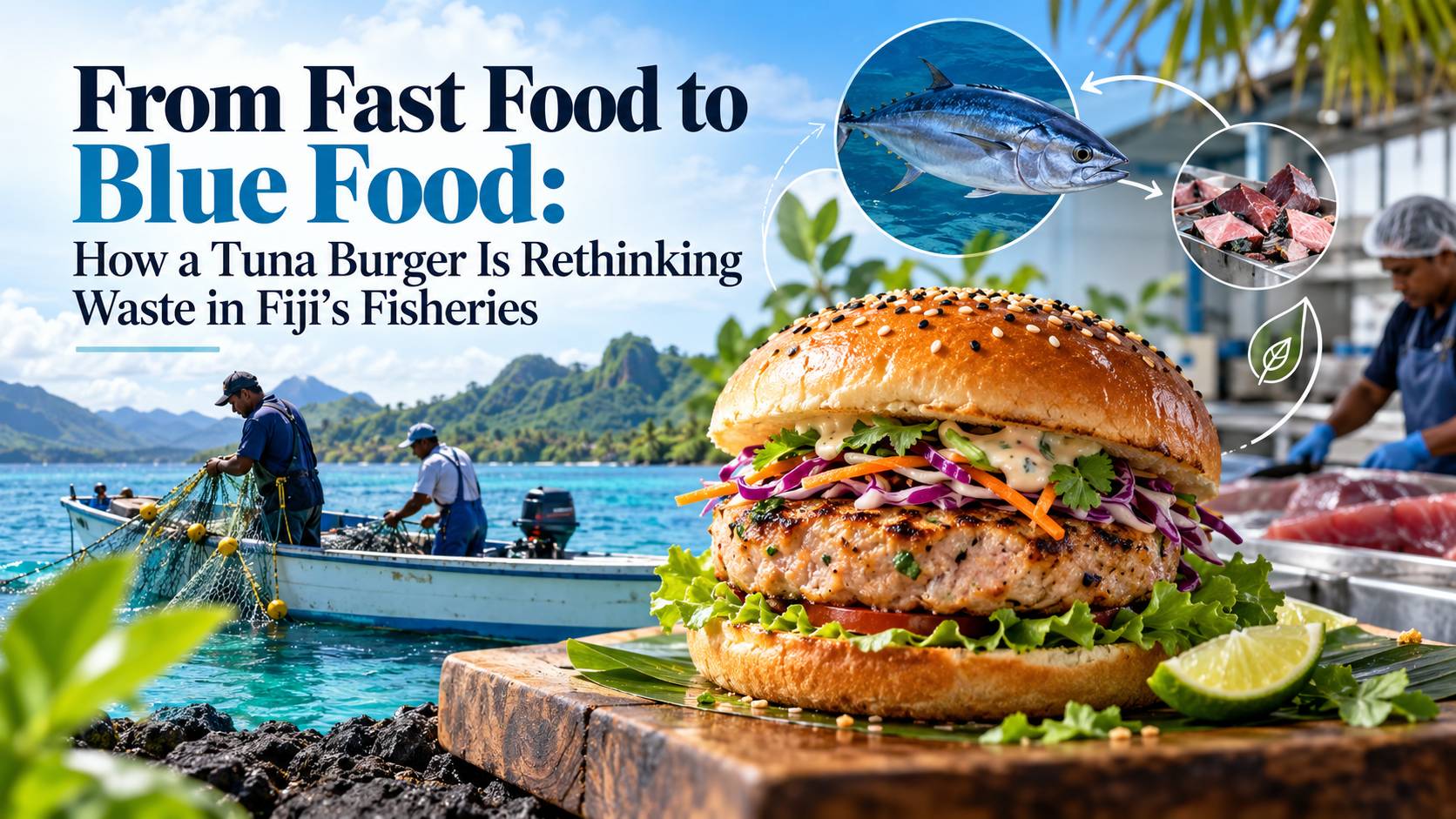
In the Pacific, the EU-funded Fiji Blue Fishing project is exploring exactly that idea.
A fish burger made from edible meat recovered from the tuna head after the main commercial cuts have been removed is among the practical solutions being developed through this initiative.
The burger may be simple, but the idea behind it addresses a much bigger challenge: how to use more of every fish that is caught, reduce food losses and waste, and create greater value from fisheries resources for the communities that depend on them.
It is an example of the project's ambition to move, quite literally, from “Fast Food” to “Blue Food” — applying circular economy and zero-waste principles to fisheries while looking for solutions that can work in Fiji's island and community context.
Why it matters: making more of Fiji's fisheries resources
Seafood plays an important economic, social and cultural role across Fiji and the wider Pacific. For many coastal communities, fisheries are not simply an industry. They provide food and income and are deeply connected to livelihoods, community organisation and traditional approaches to managing marine resources.
But island fisheries also face practical sustainability challenges.
Fish that deteriorates before reaching consumers represents both lost food and lost income. Parts of the catch that could potentially be used may instead become waste. Single-use plastics add pressure to marine environments, while remote communities can face difficulties accessing reliable energy and the infrastructure needed to keep fish fresh.
Reducing post-harvest losses, making better use of each fish landed, improving preservation, cutting plastic waste and reducing dependence on conventional energy can therefore strengthen both the environmental sustainability and the resilience of fishing communities.
This is where Fiji Blue Fishing is concentrating its efforts: connecting sustainable fisheries management with practical ways to use resources more efficiently and reduce the environmental footprint of the fisheries value chain.
Turning tuna by-products into food
The tuna burger provides one of the clearest examples. Rather than relying only on the principal commercial cuts, the recipe uses edible meat recovered from the tuna head, material that can otherwise be discarded or underutilised during processing. Recovering this meat means that a greater proportion of the fish can remain within the food chain. In doing so, the approach can help reduce food loss as well as the volume of fisheries by-products requiring disposal.
The innovation is therefore less about creating another burger than about demonstrating a different way of thinking about the catch: how much value can be retained from a fish before something is classified as waste?
It is a principle the project aims to take further as it moves from analysis toward testing practical solutions with fishing communities.
Looking at the footprint from catch to consumer
Better use of fisheries resources is only one part of the equation. Fiji Blue Fishing is also developing a Life Cycle Assessment of the fisheries supply chain to understand where the greatest environmental pressures occur, including energy and water use, materials, food losses and waste. The assessment is intended to provide a clearer evidence base for deciding where changes could make the greatest difference.
During the project's first implementation phase, hundreds of questionnaires were collected through field surveys with fishing communities. The resulting information covered fishing practices, post-harvest handling, market channels, environmental conditions and plastic use. That work fed into a Fisheries Value Chain Study and Stakeholder Mapping and Strategy Plan, tracing the fisheries chain from harvesting to final consumption and identifying opportunities to improve handling and processing, reduce post-harvest losses and introduce circular-economy approaches. For Fiji Blue Fishing, the emphasis is now increasingly on translating that evidence into solutions that communities can realistically use.
Tackling plastics through better packaging
Packaging is another area under examination. The project is assessing nature-based and environmentally friendly alternatives to conventional packaging, with particular attention to reducing single-use plastics. The challenge is not simply to identify a material that looks more sustainable on paper. Any alternative also needs to be technically viable, food-safe and appropriate for Fiji's conditions. That focus on local practicality runs throughout the project: solutions need to reduce environmental pressures, but they must also work within real fisheries supply chains and be manageable by the people expected to use them.
Could the sun help keep catches fresh?
For fishing communities, one of the most immediate sustainability issues can be remarkably basic: ice.
Reliable access to ice is essential to preserve fish quality, extend shelf life and reduce the risk of catches being lost after landing, particularly in remote communities. Fiji Blue Fishing is therefore exploring solar-powered ice production as a potential solution. Producing ice using solar energy could combine two benefits particularly relevant to an island context; namely, improving the preservation of catches while reducing dependence on conventional energy sources. Together with improved post-harvest handling, such an approach could help fishing communities retain more value from what they catch rather than losing it before it reaches the market.
Innovation that starts with communities
Technology alone, however, is unlikely to transform a fisheries value chain. The project is working through Fiji's traditional iTaukei governance structures and engaging traditional leaders, village committees, women's groups and other community actors as it develops its next phase. This community focus was also one of the aspects that attracted attention when Fiji Blue Fishing was presented at Seafood Expo Asia in Singapore in September 2026.
As Project Advisor Lucio Trifiletti explained:
Fiji Blue Fishing starts from remote island communities and actively involves small-scale fishers, showing that they too can play a role in reducing the environmental impact on the Pacific Ocean, while at the same time strengthening their capacity to generate greater value from their catches through simple, accessible and sustainable technologies.
The project's participation in the Expo, at the invitation of Italy's Ministry of Agriculture, Food Sovereignty and Forests, provided an opportunity to exchange experiences with seafood-sector actors on areas including sustainable processing, waste reduction, packaging and circular economy solutions. But the project's broader test will take place far from the exhibition floor: in whether those ideas can be adapted into workable solutions for Fiji's fishing communities.
From analysis to action
Fiji Blue Fishing is now moving into a more implementation-oriented stage. Alongside advancing its Life Cycle Assessment, the project plans to develop and test practical approaches to fish by-product valorisation, waste reduction, sustainable packaging, renewable-energy applications and improved preservation of catches.
The common thread is straightforward: get more value from fisheries resources while using fewer resources and creating less waste.
The tuna burger captures that ambition particularly well. Something that might once have been seen mainly as a processing by-product becomes food. A problem becomes a potential resource. And a familiar fast-food format becomes a vehicle for thinking differently about how fisheries can contribute to a more circular blue economy. For Fiji's fisheries, that shift from Fast Food to Blue Food may offer a small but tangible illustration of what a more sustainable value chain could look like.
About the project
Fiji Blue Fishing – Increasing Sustainability for Fishing Products Value Chain in Fiji is an EU-funded SWITCH-Asia initiative coordinated by the Institute for Research on Innovation, International Law and Sustainability (CNR-IRIDIS), together with the Locally Managed Marine Area Network International, Metellia Servizi, Nuova Ulixes Cooperative and Punta Campanella Marine Protected Area. The project combines European expertise with the knowledge and practices of Fijian communities to develop sustainable fisheries solutions adapted to local conditions.